Standing amidst the golden sands of the Thar Desert, Jaisalmer is often celebrated as a living museum of medieval India. While the towering fort remains the city’s crown jewel, the true soul of its artistic heritage lies within the intricate stone carvings of its residential mansions. Among these, none are as grand or as historically significant as the Patwon Ki Haveli. For any traveler seeking to understand the intersection of wealth, culture, and craftsmanship, a visit arranged by a professional tour operator in Jaisalmer is essential to unlocking the stories hidden in these yellow sandstone walls. This cluster of five havelis represents more than just a residence; it is a testament to the “Art of the Thar” and the architectural ingenuity of the 19th century.
The Legacy of the Brocade Merchants
The history of this architectural marvel is as fascinating as its facade. Built between 1805 and 1860, the mansion was commissioned by Guman Chand Patwa, a wealthy merchant who dealt in gold, silver, and fine brocade (Patwa). His immense wealth allowed him to hire the most skilled local craftsmen to create a structure that would showcase his status. The result was a series of five separate houses built for his five sons, which together form the largest haveli in Jaisalmer. The complex took over 50 years to complete, ensuring that every inch of the stone was treated with the precision usually reserved for jewelry making rather than masonry.
Architectural Splendor of the Five Havelis
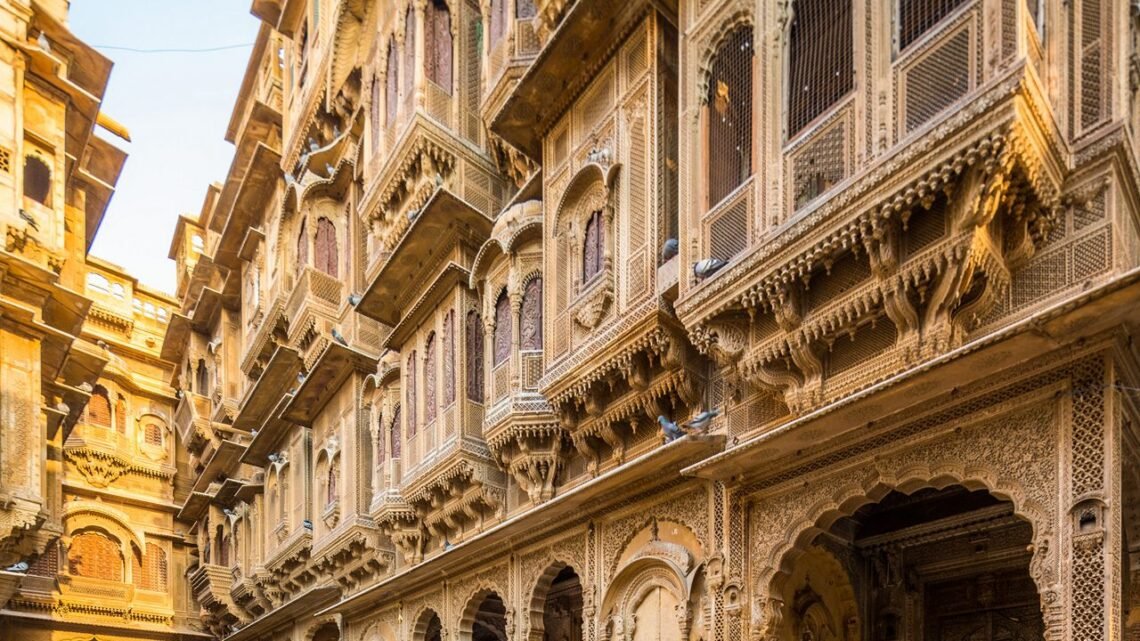
When you approach the narrow lane leading to the mansion, the sheer scale of the stone embroidery is breathtaking. The architecture is a masterclass in the Rajputana style, blended with subtle influences from the Silk Road trade routes. Unlike the fort, which was built for defense, the patwon ki haveli was built for aesthetic display and climate control. The use of yellow sandstone, locally known as “Sonu stone,” gives the building a golden glow that changes hue as the sun moves across the sky.
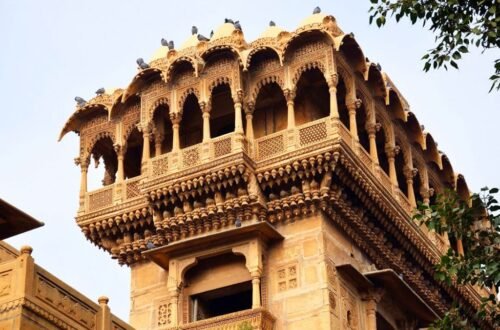
Each of the five havelis has a distinct character, yet they are unified by their shared balconies and intricate jharokhas. There are over 60 balconies in total, each featuring a unique pattern of stone latticework (jaali). These are not merely decorative; the jaali work served as a natural air conditioning system, allowing the desert breeze to cool the interiors while maintaining the privacy of the residents.
Intricate Jharokhas and Stone Embroidery
The defining feature of Patwon Ki Haveli is its jharokhas, or overhanging enclosed balconies. These structures are so finely carved that they often resemble wood or lace rather than heavy stone. The artisans used a technique called “pierced stone carving,” where the stone is hollowed out to create geometric and floral patterns.
Walking through the corridors, you will notice that no two pillars or arches are exactly the same. The ceilings are adorned with traditional paintings, and some rooms still retain the original mirror work and gold leaf paintings that reflect the opulence of the Patwa family. The first haveli, which is the most well-preserved and now serves as a museum, offers a deep dive into the lifestyle of the era, showcasing antique furniture, traditional costumes, and the tools used by the merchants.
Engineering for the Desert Climate
The architects of the 19th century were deeply aware of the harsh Rajasthan climate. The haveli is designed with multiple courtyards that act as thermal buffers. During the day, the thick sandstone walls absorb the heat, keeping the inner rooms cool. At night, this heat is slowly released, maintaining a comfortable temperature. The narrow streets surrounding the haveli also provide constant shade, a design choice that remains relevant today for anyone navigating the city. To experience these architectural nuances comfortably, many visitors prefer to hire a reliable Jaisalmer taxi service to transport them through the winding city streets to the entrance of the heritage zone.
The Symbolism in the Stone
Beyond the structural beauty, the carvings carry deep symbolic meanings. You can find depictions of peacocks, lotus flowers, and various deities carved into the lintels and door frames. These symbols were believed to bring prosperity and protection to the household. The attention to detail extends to the smallest elements, such as the stone brackets (kangni) and the water drainage systems, which were cleverly integrated into the decorative motifs. It is this marriage of function and high art that makes the Patwon Ki Haveli a primary study for architects and history enthusiasts worldwide.
Preservation and Global Recognition
Today, the haveli is partially maintained by the Archaeological Survey of India (ASI) and remains a site of immense pride for the local community. It serves as a reminder of a time when Jaisalmer was a pivotal stop on the caravan routes connecting India to Central Asia and the Middle East. The preservation of these carvings is a delicate task, as the soft sandstone is susceptible to erosion from wind and sand. However, the endurance of the structure over two centuries is a credit to the original builders’ expertise.
Why You Should Visit
A journey through Patwon Ki Haveli is a journey through time. It offers a glimpse into a world where art was not just something to be viewed, but something to be lived in. For photographers, the play of light and shadow through the stone jaalis provides endless opportunities for capturing the essence of Rajasthan. For the history buff, it is a tangible connection to the merchant princes of the Thar.
As you plan your exploration of the Golden City, remember that the architecture of Jaisalmer is best understood through its details. The grand vistas of the fort provide the backdrop, but the havelis provide the texture and the stories. By taking the time to observe the delicate “Art of the Thar” within these walls, you gain a deeper appreciation for the human spirit that thrived in one of the most inhospistable environments on earth.