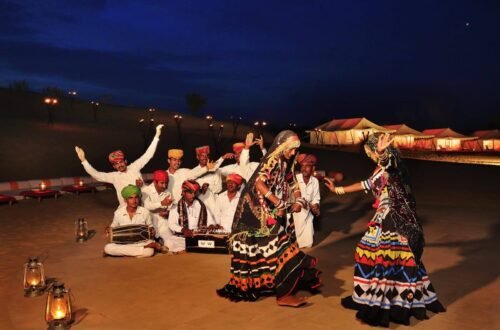
The golden mirage of Jaisalmer rising from the heart of the Thar Desert is a testament to human ingenuity and the profound relationship between geography and design. Known globally as the “Golden City,” its identity is anchored by the shimmering yellow hues of the Jurassic-sandstone used in every structure, from the towering ramparts of the Sonar Quila to the intricate facades of ancient havelis. For travelers seeking an authentic stay at a camp in Jaisalmer, the architectural transition from the rugged desert floor to the meticulously carved stone balconies provides a narrative of survival and luxury that has spanned centuries. This sandstone is not merely a building material; it is the soul of the region, dictating the lifestyle, cooling the interiors against the harsh desert sun, and creating a visual symphony that glows with a honey-like warmth at sunset.
The Geological Legacy of Yellow Sandstone
The story of Jaisalmer’s architecture begins millions of years ago when the region was submerged under the Tethys Sea. The resulting sedimentary deposits created the soft, yet durable, yellow sandstone that defines the city’s skyline today. Unlike the red sandstone of Agra or the white marble of Udaipur, Jaisalmer’s stone possesses a unique property: it changes color depending on the angle of the sun. In the early morning, the city appears pale and dusty, but as the sun reaches its zenith, the buildings radiate a brilliant gold, earning the city its famous moniker. Architects of the medieval era realized that this stone was exceptionally easy to carve while being strong enough to support massive fortifications. This led to the development of the “Jali” work—exquisite stone latticework that allows air to circulate while blocking out the intense desert glare and heat.
Survival Through Design: The Living Fort
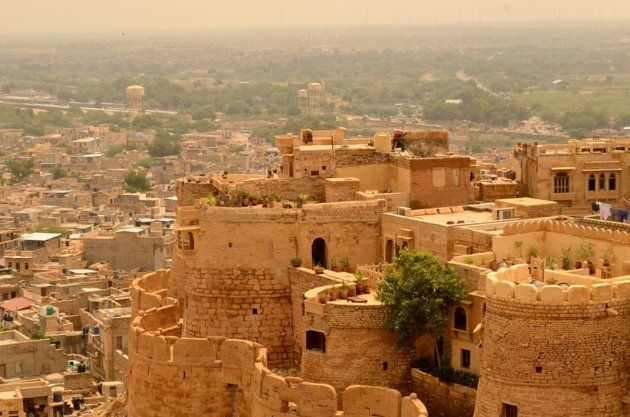
Jaisalmer Fort is one of the few “living forts” in the world, housing nearly a quarter of the city’s population within its walls. Built in 1156 AD by Rawal Jaisal, the fort’s architecture was designed specifically for defense and climate control. The massive sandstone blocks were often joined without mortar, using a groove-and-tongue method that allowed the structure to withstand seismic shifts and the shifting sands of the Thar. When visitors venture out from a Jaisalmer tent camp to explore the inner city, they notice the narrow, winding lanes. These were not accidental; the tight alleys ensure that the buildings provide shade for one another throughout the day, keeping the ground temperature significantly lower than the open desert. This expertise in urban planning demonstrates an early understanding of sustainable living in an arid environment.
The Havelis: Masterpieces of Stone Carving
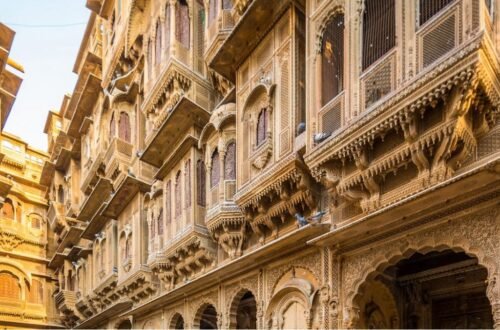
While the fort represents the city’s strength, the private mansions or “Havelis” represent its artistic peak. Patwon Ki Haveli, Salim Singh Ki Haveli, and Nathmal Ki Haveli are the primary examples of how sandstone can be manipulated to look like delicate lace. Wealthy merchants who grew rich from the Silk Road trade commissioned these homes to showcase their status. Every inch of the sandstone facade is covered in motifs of flowers, elephants, and geometric patterns. These havelis also featured “Jarokhas” (overhanging enclosed balconies), which served a dual purpose: they acted as wind catchers, funneling the desert breeze into the living quarters, and allowed the residents to observe the street life without being seen. The craftsmanship involved in these structures is so precise that modern architects still study them to understand passive cooling techniques.
Planning Your Exploration of the Golden City
Understanding the depth of this architecture requires more than a few hours. To truly appreciate the history etched into the stone, travelers often seek a comprehensive list of places to visit in Jaisalmer in 3 days to ensure they witness the transition from the city’s historic core to the surrounding cenotaphs of Bada Bagh. On the first day, a deep dive into the Fort and the central Havelis offers a lesson in medieval urbanism. The second day is often reserved for Gadisar Lake and the intricately carved temples that reflect in its waters. By the third day, the focus shifts toward the dunes, where the architecture of the desert becomes more transient, moving from permanent stone to the traditional nomadic aesthetic of desert dwellings.
The Connection Between Stone and Sand
There is a poetic continuity between the sandstone city and the rolling dunes of the Sam and Khuri regions. The architecture of the city was designed to mimic the natural landscape, making the buildings feel like an extension of the desert itself. This seamless integration is what makes Jaisalmer so visually captivating. Even the modern constructions in the city are mandated by law to use the local yellow sandstone to preserve the aesthetic heritage of the “Sun City.” This ensures that as the city grows, it does not lose the golden glow that has attracted traders, explorers, and modern tourists for generations. The relationship between the sun and the stone is a daily performance, where the architecture acts as a canvas for the shifting light of the Thar.
Preservation of a Stone Heritage
In the modern era, the preservation of Jaisalmer’s sandstone architecture faces challenges from rising humidity and modern plumbing within the ancient fort walls. However, the expertise of local stone masons, who still practice the traditional carving techniques of their ancestors, remains a beacon of hope. These artisans continue to work with the same Jurassic stone, ensuring that repairs to the havelis and the fort are done with historical accuracy. For the traveler, seeing a mason at work with a simple chisel and hammer, transforming a heavy block of stone into a delicate window screen, provides a direct link to the craftsmanship of the 12th century. It is this dedication to tradition that keeps the spirit of the Sun City alive, ensuring that its golden walls will continue to tell the story of the desert for centuries to come.