Jaisalmer rises straight out of the Thar Desert like a mirage carved from golden sandstone. Known across the globe as the Golden City, this medieval outpost served as a pivotal trade stop along the ancient Silk Road. Today, it remains one of the most culturally vibrant places in India. Planning a short escape requires careful scheduling to balance ancient ramparts, royal havelis, and sweeping sand dunes. As a dedicated tour operator in Rajasthan, Rajasthan Yatra has crafted this field-tested 48-hour itinerary to help you maximize every moment without feeling rushed.
Day 1 Morning: Exploring the Living Fort and Ancient Havelis
Begin your first morning early at Jaisalmer Fort, locally referred to as Sonar Qila or the Golden Fort. Unlike most historical fortresses across India that stand preserved as empty monuments, Jaisalmer Fort is a living settlement. Nearly a quarter of the old city’s population still resides within its towering bastions.
Constructed in 1156 AD by the Rajput ruler Rawal Jaisal, the fort features labyrinthine alleys paved with flagstones, hand-carved balconies, and bustling neighborhood squares. Enter through the grand Suraj Pol gate as soft morning sunlight strikes the yellow sandstone walls, turning them a radiant shade of amber. Inside the complex, wander toward the seven intricately sculpted Jain Temples dating between the 12th and 15th centuries. The yellow and white marble pillars, carved with celestial dancers and geometric vaults, showcase peerless medieval stonemasonry.
By late morning, descend from the fort plateau into the lower walled city to explore Patwon Ki Haveli. This cluster of five adjoining mansions was built by an affluent brocade and jewelry trader for his sons. Every exterior archway and jharokha is perforated like delicate wooden lace, demonstrating how traditional artisans created passive cooling ventilation to withstand harsh desert heat.
Day 1 Afternoon: Desert Architecture and Sunset at Gadisar Lake
Take a lunch break at a rooftop eatery near Amar Sagar Pol to savor regional staples like ker sangri, bajre ki roti, and gatte ki sabzi. Regional cuisine in western Rajasthan reflects centuries of culinary ingenuity adapted to an arid environment, utilizing desert beans, dried berries, and slow-churned ghee.
Following lunch, proceed toward Salim Singh Ki Haveli and Nathmal Ki Haveli. Salim Singh Ki Haveli features an arched roof shaped like an open peacock, supported by finely chiseled brackets. Nathmal Ki Haveli presents a unique architectural curiosity: two stonemason brothers built the left and right halves simultaneously without blueprints, resulting in subtle, charming asymmetries along its sculpted facade.
As late afternoon arrives, make your way to Gadisar Lake. Commissioned in the 14th century by Maharawal Gadsi Singh, this historic reservoir once supplied the entire desert citadel with rainwater collected through natural runoff channels. Stroll along the artistically carved pavilions and arched gateways bordering the water. A quiet pedal boat ride across the water offers a front-row view of migratory birds against the backdrop of the illuminated city fort.
Day 2: Sand Dunes, Camel Trekking, and Desert Safari
Devote your second day to experiencing the wide wilderness that defines the Thar. After breakfast, prepare for an expedition outside the urban perimeter as part of your broader Rajasthan holidays tour experience.
En route to the deep dunes, stop at the ghost village of Kuldhara. Established in the 13th century by the prosperous Paliwal Brahmins, the entire settlement was abandoned overnight in the early 1800s to escape the tyrannical taxation and oppression of a local dewan. Walking through the roofless stone homes and silent street corridors reveals an authentic chapter of desert history preserved entirely in situ.
By mid-afternoon, continue southwest toward the Sam Sand Dunes or Khuri Sand Dunes. Here, winds continuously sculpt dramatic wind-rippled crests that stretch outward toward the horizon.
What to Experience on the Desert Safari
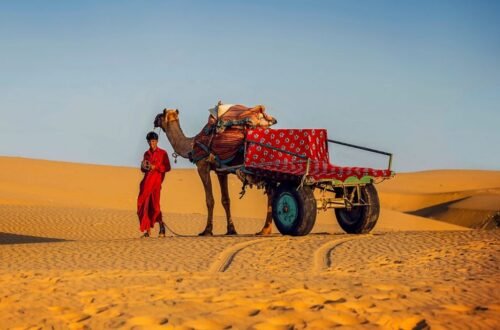
- Embark on an afternoon camel trek guided by local desert herders who understand the shifting wind currents and the best ridge positions.
- Switch to an open-top 4×4 vehicle for dune bashing across steep drops and shifting sand slopes.
- Climb a high dune crest thirty minutes before twilight to watch the desert colors shift from bright ochre to deep crimson and soft violet.
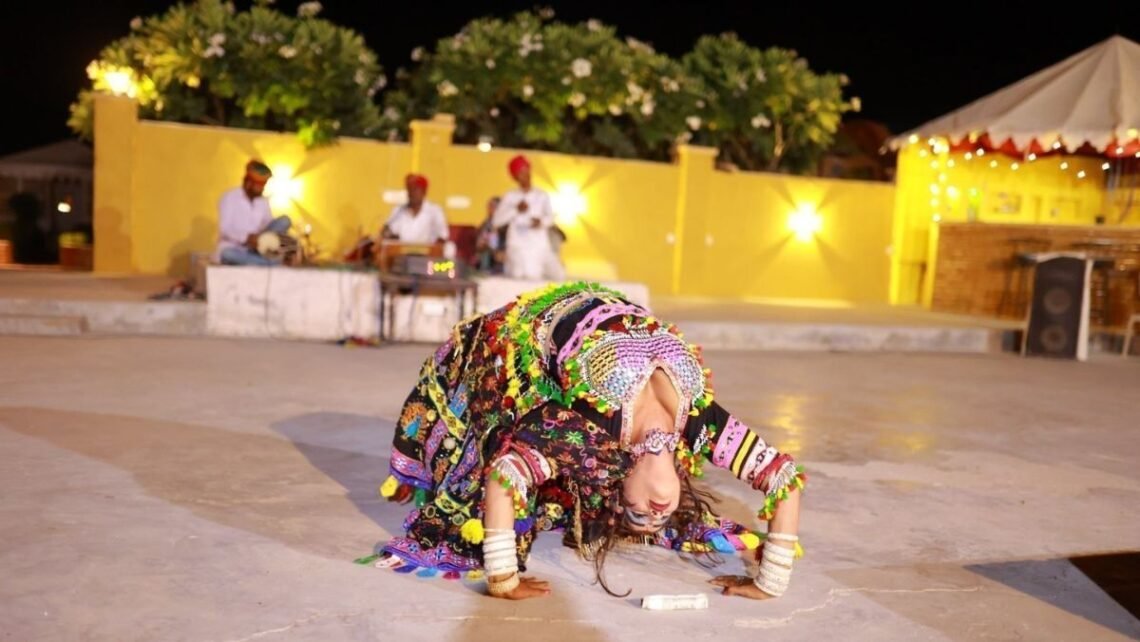
- Gather around a bonfire at a traditional desert encampment to witness Kalbelia dancers and Manganiyar musicians performing age-old Rajasthani folk melodies.
- Spend the night under clear desert skies, either in a luxury swiss tent or on a simple open cot arranged directly over the cool evening sand.
Securing a comprehensive Rajasthan desert adventure tour ensures that all your camel safaris, transfers, and camp logistics are handled with vetted hospitality providers, giving you safe, immersive desert access.
Essential Practical Advice for Visiting Jaisalmer
Timing is everything in the desert. The ideal months to explore Jaisalmer run from October through March, when daytime temperatures stay between 20°C and 28°C. During the peak summer stretch from April to June, temperatures routinely surpass 42°C, making outdoor sightseeing physically demanding.
Pack breathable cotton layers for sunny mid-days, along with a windproof jacket or wool wrap, as open desert temperatures plummet rapidly after nightfall. Sturdy walking shoes with reliable traction are essential for navigating the steep stone slopes inside Jaisalmer Fort. Always keep reusable water flasks filled to stay well hydrated during desert excursions.