Rajasthan represents a profound synthesis of royal heritage, architectural grandeur, and timeless spiritual traditions. Exploring this region requires practical field experience to balance monument timings, local transit, and cultural immersion. As an experienced team navigating the desert state’s routes daily, Rajasthan Yatra has curated this comprehensive two-city itinerary designed to maximize your time while offering deep cultural resonance.
Planning the Golden Route: Jaipur to Pushkar
Jaipur, the vibrant capital founded by Maharaja Sawai Jai Singh II in 1727, stands as India’s first planned city. Further west across the Aravali hills lies Pushkar, an ancient pilgrimage site cradling the sacred Pushkar Lake and one of the rare Brahma temples in the world. Pairing these two destinations allows travelers to experience both regal fortresses and tranquil spiritual rituals within a single circuit. To ensure seamless ground transit and local coordination across districts, partnering with a dependable travel agency in Rajasthan provides essential logistical support, licensed regional guides, and seasoned drivers familiar with highway conditions.
Day 1: Exploring the Regal Landmarks of Jaipur
A structured start is essential to appreciate the vast scale of the Pink City before daytime crowds gather.
Morning: Hilltop Fortresses and Panoramic Vistas
Begin at 8:00 AM by heading toward Amer Fort, situated approximately eleven kilometers outside the core city. This UNESCO World Heritage site showcases Rajput and Mughal architectural harmony with red sandstone and marble courtyards.
Key architectural elements to inspect closely include:
- The Sheesh Mahal, where thousands of convex mirrors reflect candlelight across intricate floral plasterwork
- The Diwan-e-Aam, elevated on double rows of columns crafted to receive public petitions
- The historic Maota Lake viewpoint, which once served as the primary water reservoir for royal defense
On your return down the Amer road, pause at Jal Mahal. This water palace rests serenely in the middle of Man Sagar Lake, offering exceptional photography angles against the Aravali backdrop.
Afternoon: The Administrative and Astronomical Core
By midday, transition into the old walled city through its traditional gates. A well-organized Jaipur full day tour enables visitors to cover the City Palace complex efficiently. The museum galleries inside the Mubarak Mahal and Chandra Mahal preserve royal textiles, royal armory, and ceremonial costumes dating back several centuries.
Directly adjacent to the palace grounds lies Jantar Mantar, an astronomical observatory established between 1724 and 1734. The site features nineteen monumental stone instruments, including the Vrihat Samrat Yantra, the world’s largest stone sundial, capable of measuring local solar time with an accuracy of two seconds.
Late Afternoon and Evening: Streetscapes and Bazaars
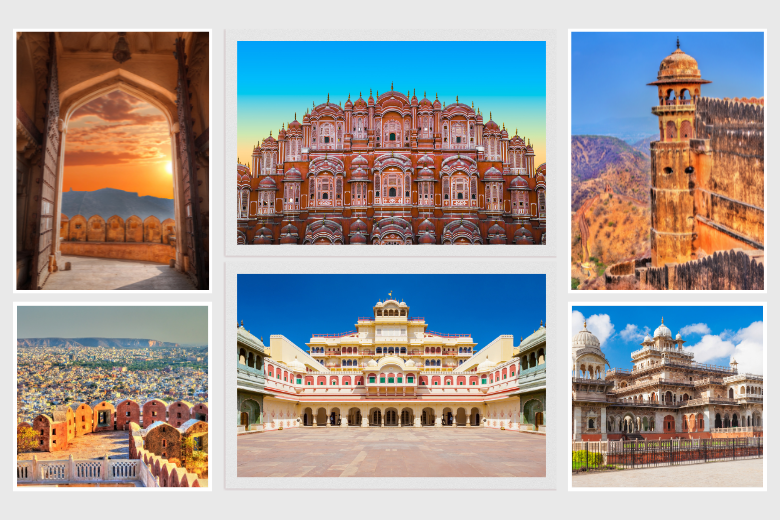
Conclude the daylight hours at Hawa Mahal, the Palace of Winds. Built in 1799 by Maharaja Sawai Pratap Singh, its five-story facade contains 953 jharokhas (small casements) designed to funnel cool desert breezes while allowing royal women to observe market processions unseen. Spend the evening walking through Johari Bazaar and Bapu Bazaar, where traditional block prints, blue pottery, and handcrafted silver jewelry reflect generations of hereditary craftsmanship.
Day 2: Journey to the Sacred Oasis of Pushkar
Pushkar presents an entirely different cultural pace, characterized by temple chants, desert breezes, and lakeside ghats. Travelers with limited schedules often opt for a coordinated Jaipur with Pushkar say tour to complete this route comfortably within an organized timeframe.
The Highway Transit
The 145-kilometer drive from Jaipur to Pushkar via National Highway 48 takes roughly three to three and a half hours. Leaving Jaipur by 7:00 AM avoids highway truck bottlenecks, ensuring arrival in Pushkar before midday heat sets in.
Midday: The Revered Jagatpita Brahma Temple
Upon entering Pushkar, proceed directly to the Brahma Temple, dating to the fourteenth century with structures tracing back even earlier. Approached by marble steps, the sanctuary features a distinctive red spire (shikhara) and the emblem of a hamsa (swan). Entering the inner sanctum reveals the four-faced icon of Lord Brahma, surrounded by silver coin offerings embedded into the flooring by centuries of pilgrims.
Afternoon: The Ghats of Pushkar Lake
Pushkar Lake features fifty-two continuous bathing ghats surrounding its perimeter. Varaha Ghat, Brahma Ghat, and Gau Ghat hold historical and spiritual significance. Observing local rituals here requires cultural etiquette:
- Remove footwear at marked boundaries before stepping onto stone ghat stairs
- Avoid photographing individuals performing personal spiritual ablutions
- Respect traditional offerings, focusing on the historical ambiance and temple architecture surrounding the water
Late Afternoon: Savitri Temple and the Thar Sunset
Ascend Ratnagiri Hill toward the Savitri Temple via the walking pathway or the passenger cable car. Dedicated to Brahma’s first consort, Goddess Savitri, this vantage point provides panoramic vistas of Pushkar town, the surrounding desert sands, and the distant mountain ranges. As the sun sets across the landscape, the shifting desert light illuminates the white temples and waters below, offering a quiet, contemplative conclusion to your journey through the royal and sacred heartlands of Rajasthan.